Get started
Overview
Learned neuron models for fast population simulation and inference-time adaptation.
AxoSim approximates the response of detailed biological neurons to synaptic input histories. You can load trained GRU and Mamba models, construct populations with explicit dendritic contacts, and adapt neuronal and synaptic parameters through a complete temporal sequence.
Start with a neuron model
Use model selection to choose a temporal architecture and backend, then load a checkpoint to predict spike logits and somatic voltage. The common single-neuron contract is an input tensor shaped (batch, time, input channels) and an output tensor shaped (batch, time, 2).
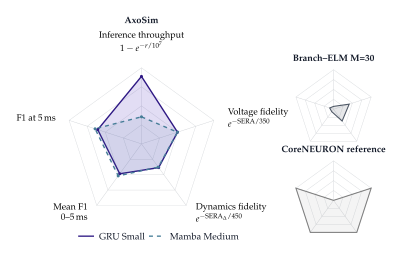
The trained architectures extend the branching mechanism of Branch-ELM. Signed input events preserve their dendritic destinations, while GRU or Mamba temporal cores model the response history. Under the standard AxoBench evaluation, GRU Medium reaches spike Mean F1 0.522, compared with up to 0.077 for released Branch-ELM models, and reduces Voltage and Dynamics SERA by 21.3% and 4.4%. In the matched inference benchmark, it processes 16.8 million neuron-steps per second. See the report for the dataset, calibration, hardware, and precision contracts.
Connect and adapt populations
The population interface combines a compact AxoSim-Lite neuron model with morphology identities, dendritic contact routes, and independently mutable synaptic efficacies. Sparse events preserve contact identity without allocating a dense contact history. Inference-time adaptation selects behavior, morphology, and synaptic parameter groups while differentiating through the supplied sequence.
The optimized runtime evaluated in the report simulates 65,536 neurons with 4,000 retained contacts per neuron at 3.38× real time on an RTX 5090. Full BPTT reaches real time for 20,000 neurons with 2,000 retained contacts. These measurements describe the frozen benchmark implementation; the supported public Python constructor is AxoSimPopulation. Reproducibility and deployment explains how to recover the reported evidence and which interfaces are available for your own code.
Follow the lifecycle
- Install AxoSim and inspect the model presets.
- Choose a model, run inference, and train on your data.
- Build a population, then use sparse contact events for sparse inputs.
- Adapt parameter groups and capture repeated CUDA updates when shapes are fixed.
- Evaluate on AxoBench, obtain the datasets, and preserve reproducibility records.
- Use the API reference for exact signatures, defaults, and source links.
Cite AxoSim
The technical report is by Davide Wiest, Axym Labs. AxoBench introduces the core metric set used throughout the report: spike Mean F1, Voltage SERA, and Dynamics SERA. SERA denotes the squared error metric; Root-SERA is its square root.
@techreport{wiest2026axosim,
  title = {AxoSim: Learned Neuron Models for Fast Population Simulation
           and Inference-Time Adaptation},
  author = {Wiest, Davide},
  institution = {Axym Labs},
  year = {2026},
  url = {https://axo.axym.org/report/main.pdf}
}